Sore muscles after a workout: what helps and how long it lasts
In short
- Muscle soreness after a workout, called DOMS, peaks 24-72 hours after training and fades within a few days.
- It comes from small muscle damage after new or eccentric work, not from lactic acid.
- Massage helps most according to a 2018 meta-analysis. Stretching barely changes soreness.
- Light activity is fine while sore. Sharp pain, swelling or dark urine need a doctor.
Sore muscles after a workout are normal, especially after new exercises or the first weeks of a program. This soreness is called delayed onset muscle soreness, or DOMS. It usually peaks 24-72 hours after training and fades within 3-5 days. According to a 2018 meta-analysis by Dupuy and colleagues, massage is the most effective recovery method for soreness, while stretching barely helps.
Why muscles get sore after a workout
DOMS comes from small damage to muscle fibres and the inflammation that repairs them. It is strongest after eccentric work, when the muscle lengthens under load: lowering into a squat, the way down in a push-up, walking downhill (Cheung and colleagues, 2003).
It is not caused by lactic acid. Lactate clears from muscles within an hour after training, long before soreness begins.
How long sore muscles last
| Time after training | What you feel |
|---|---|
| 0-12 hours | little or nothing |
| 24-72 hours | peak soreness, stiffness, tenderness to touch |
| 3-5 days | soreness fades |
| more than 7 days | unusual, worth checking with a doctor |
The same workout causes much less soreness the second time. This is called the repeated bout effect, and it is why soreness is worst in the first week of a new program.
What helps sore muscles
The meta-analysis by Dupuy and colleagues (2018) pooled 99 studies on recovery methods.
| Method | Effect on soreness |
|---|---|
| Massage | the strongest effect |
| Compression garments | moderate effect |
| Cold water immersion | moderate effect |
| Light activity, easy cycling or walking | short-term relief (Cheung and colleagues, 2003) |
| Stretching | almost no effect |
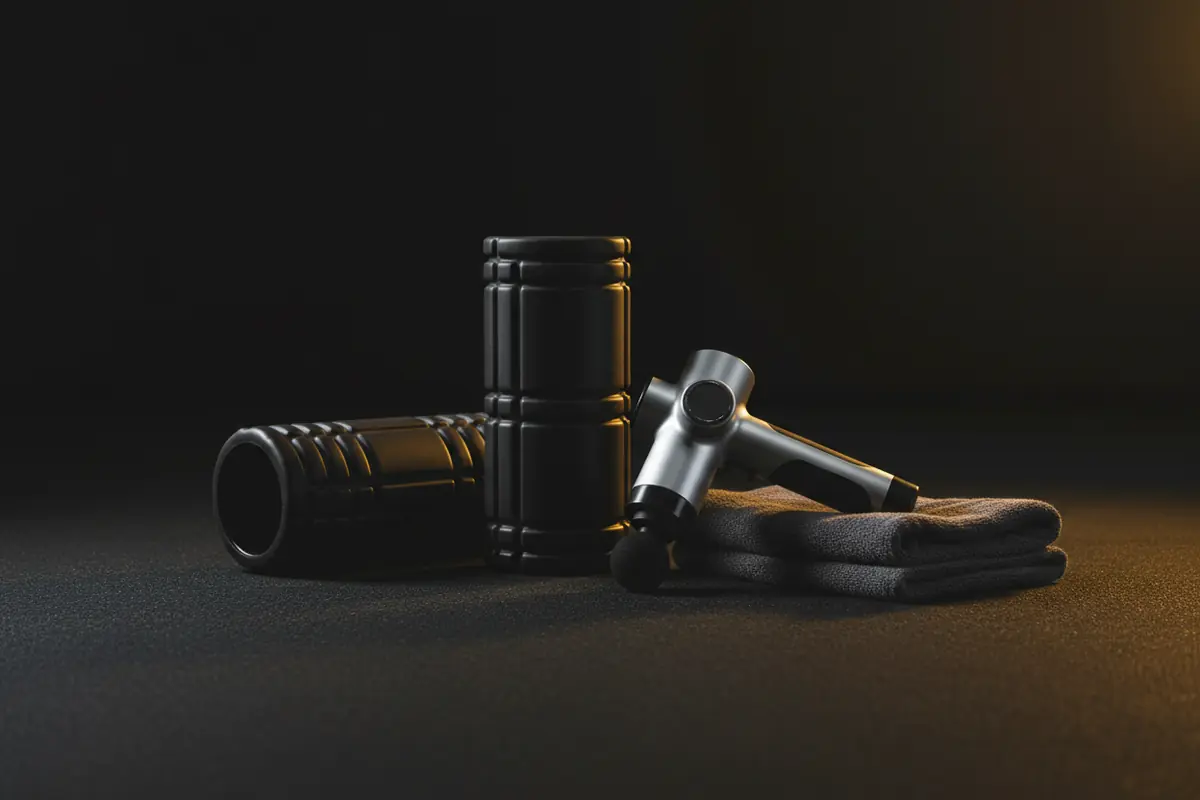
You do not need a therapist for the top option: a foam roller or a few minutes of self-massage on the sore muscle is a reasonable start. A Cochrane review by Herbert and colleagues (2011) found that stretching reduced soreness by less than 2 points on a 100-point scale. It is fine for flexibility, but not as a soreness cure.
Your muscles rebuild while you sleep, so a short night makes soreness feel worse. Aim for 7-9 hours and enough protein. The protein calculator shows your daily target.
Should you train with sore muscles?
Light training while sore is safe and often makes you feel better. Two rules keep it productive:
- Train other muscles. If your legs are sore, do upper body or a walk. A split like upper lower does this naturally.
- Go lighter on the sore muscle. If you must train it, use about half the usual weight and skip the hardest sets.
How to prevent heavy soreness
- Start a new program with lighter weights and fewer sets for the first one or two weeks.
- Add load gradually: more reps first, then more weight.
- Repeat exercises for several weeks instead of changing them every session.
A program that starts easy, like the full body routine for beginners, keeps soreness low from the start.
When soreness is a warning sign
See a doctor if you have sharp or one-sided pain, swelling, pain that gets worse after 3 days, weakness that does not improve, or dark brown urine after a very hard session. Dark urine with severe pain can be a sign of rhabdomyolysis, a rare but serious condition.
Bottom line
Soreness is a sign that your body is adapting to new work. A walk, a foam roller and a good night of sleep are usually the best cure, and the same workout will hurt far less next week.
Tonus programs start with lighter weeks and add load gradually, which keeps soreness manageable. If a muscle still aches, you can swap the exercise or move it to another day right in the workout.
Frequently asked questions
Should I work out with sore muscles?
Light training is fine and can even ease soreness. Avoid heavy work for the same muscle until the soreness drops, and train other muscle groups instead.
Does soreness mean a good workout?
No. Soreness mostly shows that the work was new or unusual. As you get used to a program, soreness drops while muscle keeps growing.
Does stretching prevent sore muscles?
Barely. A Cochrane review of 12 studies found that stretching before or after exercise reduced soreness by less than 2 points on a 100-point scale.
Sources
- Cheung K. et al. Delayed onset muscle soreness: treatment strategies and performance factors. Sports Med, 2003 doi.org/10.2165/00007256-200333020-00005
- Dupuy O. et al. An evidence-based approach for choosing post-exercise recovery techniques to reduce markers of muscle damage, soreness, fatigue, and inflammation: a systematic review with meta-analysis. Front Physiol, 2018 doi.org/10.3389/fphys.2018.00403
- Herbert R. D. et al. Stretching to prevent or reduce muscle soreness after exercise. Cochrane Database Syst Rev, 2011 doi.org/10.1002/14651858.CD004577.pub3
This article is for general information and does not replace medical advice.